Where the Clouds Bow Down: A Pilgrimage to Dzukou
Trek through Dzukou Valley in this personal travel journal that captures the silence, beauty, and inner stillness found beyond Nagaland’s misty ridges. A soulful journey of slowing down and truly listening.
ADVENTURE & ROUTESNAGALANDFEATURED STORIES
6/11/20252 min read
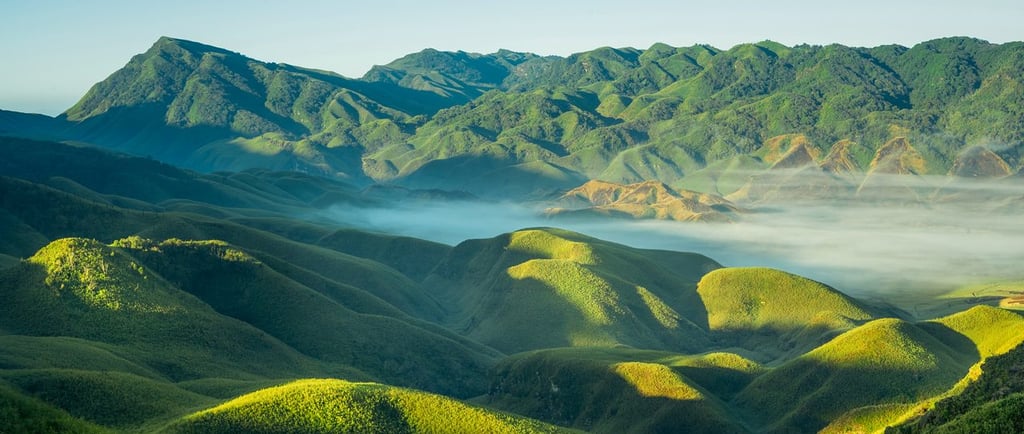
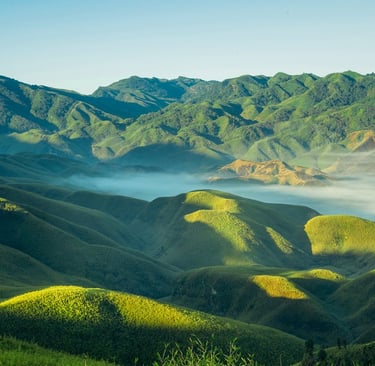
I came to Dzukou Valley chasing a photograph. The kind with rolling green hills, wildflowers in bloom, and mist curling over the ridges. I imagined the perfect frame: me, triumphant, arms wide, the valley stretching behind. But Dzukou had other plans. It didn’t offer me a view to capture. It offered me silence. And in that silence, I learned to listen.
The journey began in Kohima, Nagaland’s capital, where life moves with a kind of unhurried rhythm. From there, I took a cab to Viswema village, the quieter route to Dzukou. It was early morning when I started the trek, a mist clinging to the trees, the chill of altitude wrapping around my shoulders. The first part of the climb was brutal. A steep, stone-strewn trail that had my lungs burning and my inner monologue filled with doubt. I passed no one, and no one passed me. It was just me, the crunch of my boots, and the breath of the forest.
But somewhere between gasping steps and forced breaks, something shifted. The noise in my head began to quiet. The rhythm of walking took over. I noticed the way the light filtered through pine needles, how bamboo groves swayed with the wind like they were keeping time. A small bird landed on a branch just ahead, cocked its head, and darted off. I didn’t need music. The forest was playing its own.
When the trail finally leveled out, the world opened. I stepped into the Dzukou Valley and stopped. There it was—not just beauty, but presence. A living, breathing bowl of green, its hills rolling like waves frozen in motion. The famed Dzukou lily peeked from the grass, its petals catching the light. Streams glinted like glass ribbons. Clouds dipped low, touched the earth, and moved on.
There were no phone signals, no distractions. I stayed in a basic wooden hut near the valley, sharing it with a handful of other trekkers. We cooked together, boiled tea over open flame, shared meals in silence and stories by firelight. No one reached for their phone because there was no signal to reach for. Evenings melted into night without agenda.
In that stillness, I remembered how to pay attention. To people. To the feel of cold water on my face from the stream. To my own breath. I hadn’t realized how much noise I had been carrying. The valley didn’t ask me to drop it. It simply waited until I did.
The walk back down was easier, not because my legs had grown stronger, but because my mind had grown quieter. I paused often—to take in the view, to thank the land, to say goodbye. A monk once told me, "Silence is not empty. It's full of answers." In Dzukou, that line made sense.
Now, when I think of the valley, I don't picture the perfect shot. I remember the hush of wind over grass, the weight of a simple meal shared with strangers, the gift of unfiltered quiet. I came to Dzukou looking for views. I left with silence—and a feeling I didn’t need to fill it.