Stone and Story: A Day Among the Gods of Unakoti
Explore the ancient rock carvings of Unakoti, where myth, memory, and devotion still echo through stone. A reflective journey into Tripura’s most sacred open-air sanctuary.
TRIPURACULTURE & HERITAGEEDITOR'S PICKS
6/21/20253 min read
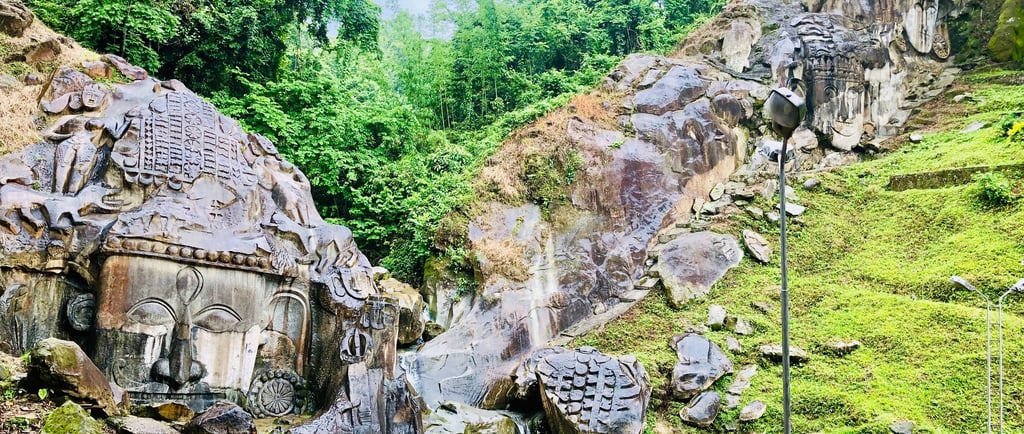
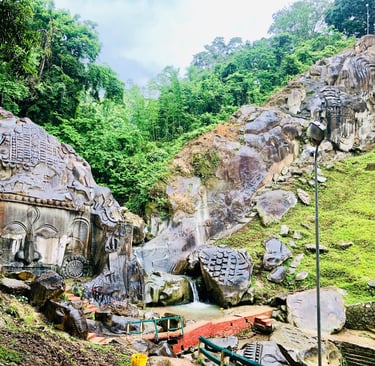
Unakoti doesn't announce itself. There’s no grand gateway, no marble-floored entrance. Just a forest, a slope, and stone faces waiting. I arrived early, when the mist still clung to the trees and the path felt more like a suggestion than a trail. My guide, an elderly man named Haradhan, walked ahead with the familiarity of someone who had grown up among gods.
"We say there are a crore carvings," he said, chuckling, "but we stopped counting long ago."
The name 'Unakoti' means 'one less than a crore'—a myth wrapped in numbers. The legend goes that Lord Shiva was traveling to Kashi with a crore gods and goddesses. They stopped here overnight. At dawn, only Shiva woke. In anger, he cursed the rest to turn into stone. What remains are their frozen forms: colossal heads, delicate engravings, and scattered figures etched into hill and boulder.
As we descended deeper into the forest, Haradhan shared another tale: that a sculptor tried to carve one crore figures in one night to win divine favor, but fell short by one. “He gave everything,” Haradhan said, “but even gods leave things unfinished.”
Unakoti isn’t a museum. It’s lived in. I saw a woman lighting incense at the base of a weather-worn Ganesha. She didn’t look up as I passed. “They live here,” she said, eyes still on the flame. “We just visit.”
Near the main shrine, I met a local priest who comes every morning before sunrise. He walked barefoot and carried a small bell, his voice rising softly in chants. "They may be stone," he said, "but stone remembers prayer."
The main face of Shiva—Unakotiswara Kal Bhairava—stood over thirty feet tall, his headdress a tangle of intricate curls and smaller figures. Moss had settled into his eye sockets, vines draped like offerings. I stood quietly, humbled. This wasn’t a ruin. It was a still-beating altar.
Children played nearby, their laughter soft against the silence of stone. Haradhan pointed to a partially submerged carving of a goddess. "Rain hides her sometimes. But she always comes back." A nearby vendor, arranging offerings of marigold and turmeric, chimed in: "And when she comes, the birds return too."
We walked further, tracing the faint lines of carvings lost to weather and neglect. Faces had faded, but outlines lingered—cheeks, brows, halos carved into cliffside. One figure, barely visible, had been re-outlined with vermillion and rice paste by a recent pilgrim. "They try to keep the gods awake," Haradhan said.
The carvings date back to the 7th–9th centuries, some say even older. Yet there’s no fencing, no glass case, no hushed audio guides. Just time and reverence—or neglect, depending on whom you ask. Locals sweep the pathways, offer flowers. The state talks of tourism plans. But the gods seem uninterested in marketing.
We passed a group of artists sketching the carvings in charcoal. One of them, a young woman from Agartala, said, “I came for art school credit. But I’m staying because these faces won’t leave me alone.”
Further up, we sat by a pool where travelers once rested. Haradhan peeled an orange and handed me half. “You see the faces. But listen to the silence too,” he said. “That’s where the old stories live.” We sat for a long time, not speaking, just watching the light shift through the trees.
As we made our way back, I noticed several stones painted not by artisans but visitors—symbols, initials, prayers in many languages. It felt intimate, not invasive. Like people reaching across time to say, "I was here. I heard you."
When I left Unakoti that afternoon, the mist had lifted. But the faces remained—half-seen, half-felt. Not relics. Not attractions. Just gods in waiting, their stories carved in stone and carried in memory.